



Best Baby Food Pouches (2025 Guide)
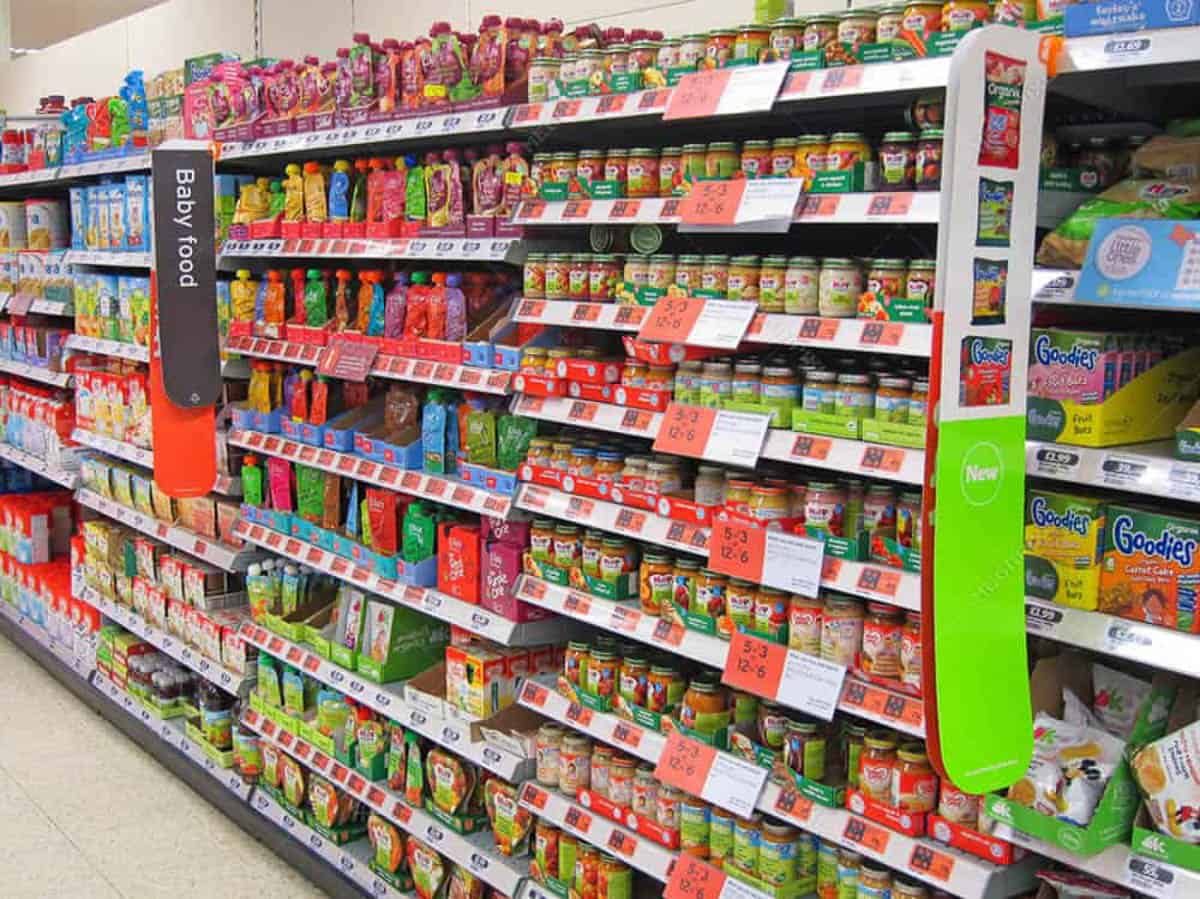
This post may contain affiliate links. As an Amazon Associate, I earn from qualifying purchases. Please read my disclosure.Looking for the safest baby food pouches that aren’t loaded with sugar or heavy metals? I tested dozens of brands with my two kids and found that Cerebelly, Serenity Kids, Once Upon a Farm, White Leaf Provisions, and Holle are the only pouches I trust enough to keep stocked in my pantry. Why did these brands come out on top? Here’s everything I learned about choosing pouches that are actually nutritious for your little one.
Summary: Best Baby Food Pouches
Below are my top 5 recommendations for the healthiest baby food pouches on the market today! Read on for the details on each one, including my tips for the ideal ingredients, what to look for, and what to avoid!
#1: Cerebelly
#2: Holle Organic
#3: Serenity Kids
#4: Once Upon A Farm
Table of Contents
hide
My Story With Baby Food Pouches
When my daughter started solids, I was that mom making every single batch of baby food from scratch. I loved knowing exactly what went into her meals. But then my son came along, and suddenly I had a toddler and a baby, and homemade baby food became a luxury I couldn’t always manage.
That’s when I started reaching for pouches during our busiest moments. Airport trips. Long car rides. Busy days and more. I assumed that buying organic pouches meant I was giving my kids something healthy and safe.
Then I read the 2021 Congressional Report on heavy metals in baby food. Now, I was already buying pouches that were vegetable-forward, organic, and were low in sugar, but I couldn’t believe that some of the pouches I’d been buying for months were made by companies that were high in heavy metals.
I spent the next few weeks researching every baby food brand I could find. I looked at Consumer Reports data, Clean Label Project certifications, ingredient lists, and sugar content. I ordered pouches from over 20 different brands, taste-tested them myself, and also gave them to my kids to try.
What I learned changed everything about how I buy pouches. While many baby food brands don’t meet my standards, I did find a handful of companies making pouches I feel confident giving to my kids. And now I’m sharing exactly which ones made the cut and why.
Disclaimer & Methodology
As a board-certified health coach and certified nutritionist, I only recommend baby food brands made with whole foods, no added processed sugars, and verified low heavy metal levels through third-party testing. This approach is grounded in research showing that early sugar exposure shapes taste preferences for life, and that heavy metals can harm developing brains and bodies.
This post has also been medically reviewed and fact checked by Linzy Ziegelbaum, MS, RD, CDN (see my about page for more info about Linzy).
Though I may receive a commission (at no extra expense to you) through the affiliate links provided, I only recommend products I’ve researched thoroughly, consulted experts about, and feel comfortable giving to my own kids. By purchasing through the links below, you help keep this blog running, so thanks for your support!
Important: Always speak with a registered dietitian or physician about your child’s diet before making changes. The information here is not a substitute for professional medical advice. Never disregard or delay seeking professional help because of something you read here.
The Healthiest Baby Food Pouches (What I Actually Buy)
After testing dozens of brands, I found only five pouch companies that meet my standards for safety and nutrition. Each one is Clean Label Project certified or Consumer Reports verified – these are independent organizations that test for over 400 contaminants including heavy metals, pesticides, and chemicals. And every pouch I’ve chosen has 8 grams of sugar or less per pouch (ideally under 6g), uses organic ingredients, and features vegetables prominently in their blends.
I keep all five of these brands in my pantry and rotate through them depending on what’s available and what’s on sale. Here’s why each one earned a spot in my kitchen.
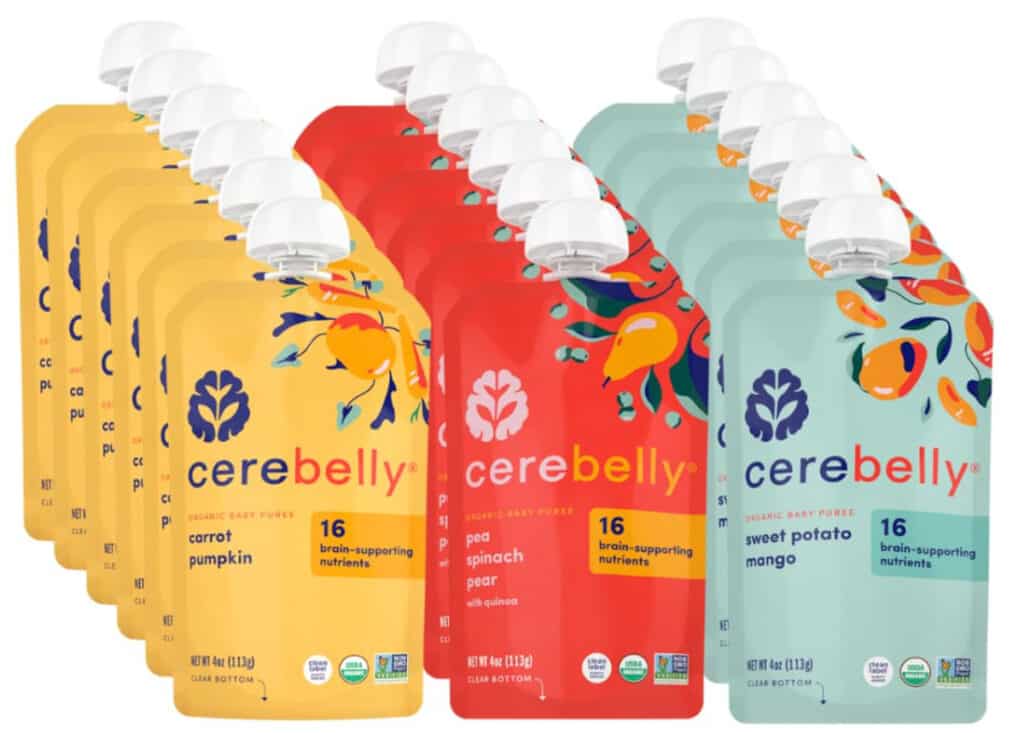
Why I Trust It: Cerebelly was created by a neurosurgeon and mom of three who wanted baby food that actually supported brain development. Every pouch contains omega-3s (DHA from algae), to mimic the DHA found in breast milk that supports cognition and behavior.
Cerebelly was the first shelf-stable baby pouch to receive Clean Label Project certification, which means they passed testing for 400 different contaminants. When I called their customer service to ask about their testing protocols, the representative walked me through their entire quality control process. That level of transparency made me trust them even more.
I love that Cerebelly pouches work for a wide age range. My kids ate them starting at 6 months, and honestly, up until about age 8, they were still grabbing them for after-school snacks. The White Bean Pumpkin Apple variety was our go-to for road trips because it kept both kids happy.
Cerebelly also offers a personalized quiz on their website where you answer questions about your baby’s age and eating habits, and they recommend the right pouches. I used this when my youngest was 8 months old and dealing with constipation, and they suggested varieties with more fiber and probiotic support. It actually helped.
What I Buy And Recommend:
- White Bean Pumpkin Apple
- Carrot Pumpkin
- Spinach Apple Sweet Potato
- Butternut Squash White Bean
- Sweet Potato and Pinto Bean
Price: $35.96 for 12 pouches (or almost $3/pouch) or subscribe and save for up to 15% off.
Where To Find It: Cerebelly’s Website, Amazon, Whole Foods, Target, Walmart
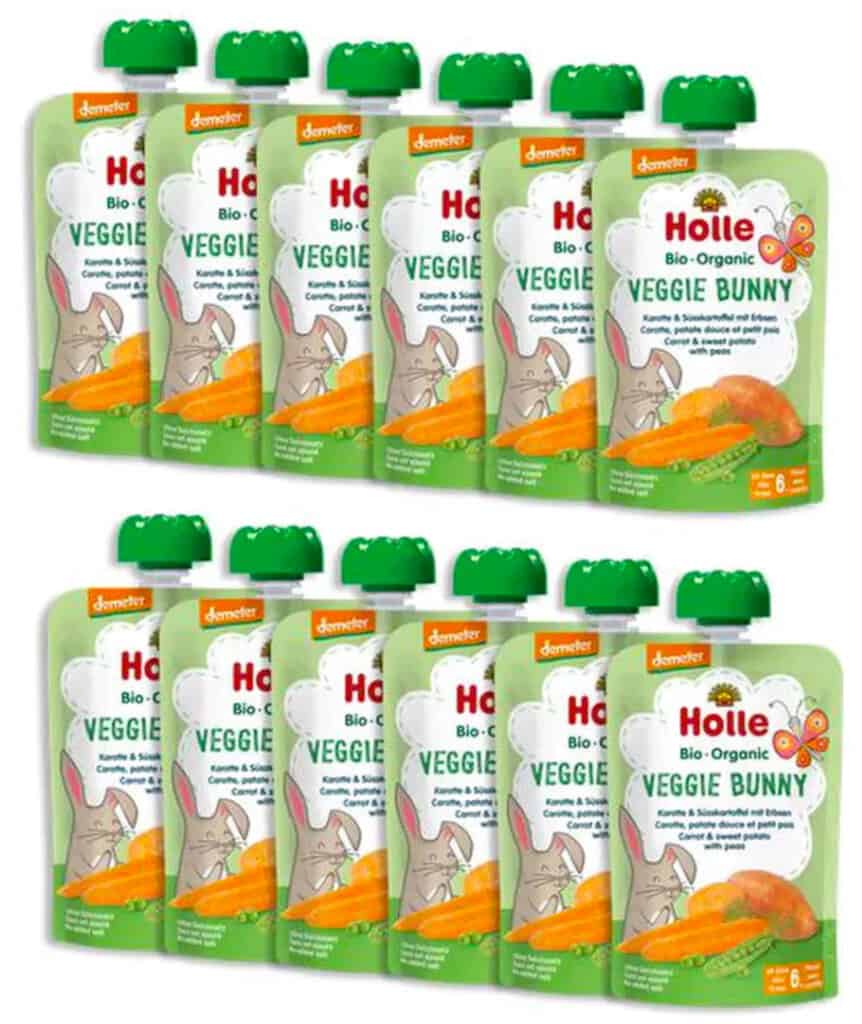
Why I Trust It: Holle has a long standing reputation for making some of the cleanest baby products. Their organic formula is one of my absolute favorites, so when I discovered they made pouches too, I ordered a case immediately.
Holle is certified both organic and biodynamic, which means their farming practices go beyond regular organic standards. Biodynamic farms work with nature’s rhythms and focus on soil health, which matters because healthy soil means fewer heavy metals in food. Every Holle pouch is made in Europe with just fruits and vegetables. No added sugars, no fillers, no juice concentrates. When my daughter tried the Veggie Bunny variety for the first time, she said it tasted “like real carrots from our garden,” which is exactly what I want.
What I Buy And Recommend:
- Veggie Bunny: Carrots, Sweet Potatoes, and Peas
- Power Parrot: Pear, Apple, Spinach
- Zebra Beat: Apple, Banana, Beetroot
Price: $35.88 for 12 pouches (or $2.99/pouch)
Where To Find It: Organic’s Best, Amazon, Whole Foods
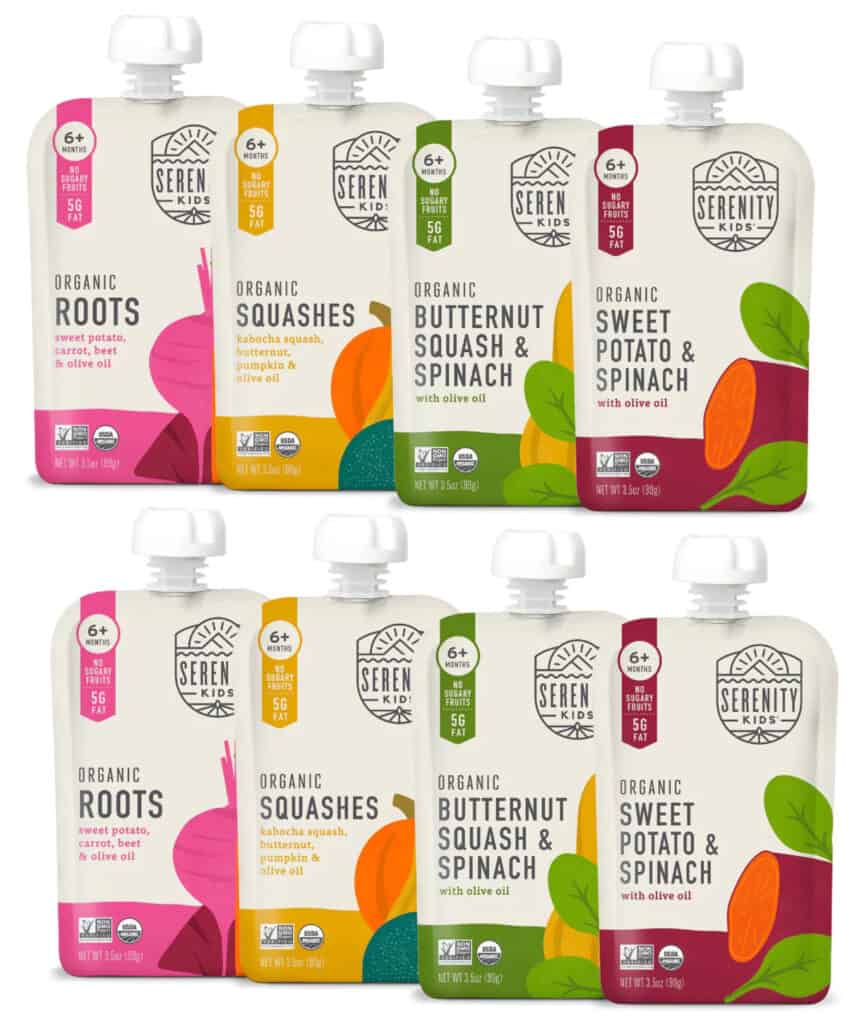
Why I Trust It: Every single Serenity Kids pouch has less than 5 grams of sugar. When I first discovered this, I couldn’t believe it. Most pouches have 10-13 grams. Serenity Kids keeps sugar low by skipping the fruit-heavy blends and focusing on vegetables with small amounts of fruit just for palatability.
The company was started by a husband and wife who experienced health problems from their own childhood diets and wanted something better for their daughter. They test every batch through Clean Label Project and hold themselves to European safety standards, which are stricter than US regulations.
I started buying Serenity Kids when my youngest was going through a phase where he’d only eat sweet foods. I needed pouches that wouldn’t make the problem worse. The Organic Squashes variety (kabocha, butternut, and pumpkin) became his favorite, and gradually his palate expanded to accept other vegetables at meals too. While I have only tried their vegetable pouches (because we are fully plant-based), their meat pouches with beef, chicken, pork, or salmon are also great for adding protein without any sneaky sugars or processed ingredients.
What I Buy And Recommend:
- Organic Squashes: Kabocha Squash, Butternut Squash, & Pumpkin
- Organic Butternut Squash & Spinach
- Organic Carrot, Spinach, & Basil
- Organic Carrots: Orange, Purple & Yellow
- Organic Sweet Potato & Parsnip
- Organic Roots: Sweet Potatoes, Carrots, & Beets
- Organic Sweet Potato & Spinach
- Organic Fruit & Vegetable Variety Pack
Price: $33.95 for 8 pouches ($4.24/pouch) or subscribe and save for up to 20% off.
Where To Find It: Company Website, Amazon, Target, and Whole Foods.
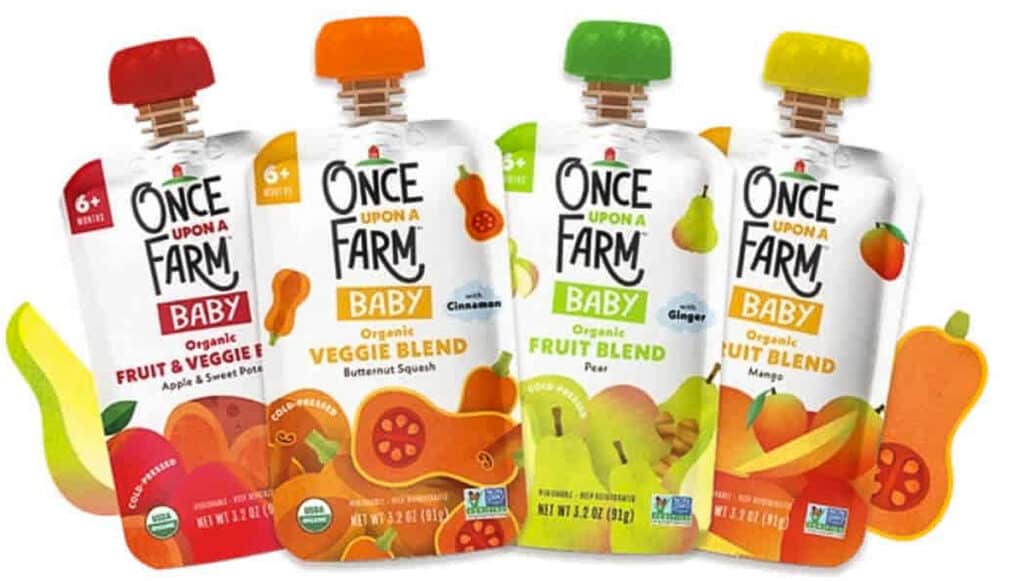
Why I Trust It: Once Upon a Farm partnered with actress Jennifer Garner and former Annie’s CEO John Foraker to expand into one of the most widely available clean baby food brands. You can now find them in over 13,000 US stores, which means I can grab them even when I’m shopping at our regular grocery store instead of making a special trip to Whole Foods.
What sets Once Upon a Farm apart is their cold-pressure processing. Most pouches are heated to high temperatures to kill bacteria, which also destroys nutrients. Once Upon a Farm uses high pressure instead of heat to eliminate pathogens while keeping vitamins and minerals intact. This is why their pouches are refrigerated instead of shelf-stable.
I noticed the difference immediately when my daughter tried their Butternut Squash with Cinnamon. She said it tasted “fresh” and “sweet,” not like the flat, cooked flavor of shelf-stable pouches. The company also works hard to keep products cold during shipping, which gives me confidence that what arrives at the store is still high quality.
Once Upon a Farm is also the first fresh baby food brand available for WIC, and they’ve partnered with Save the Children to provide 1 million meals to kids in food-insecure areas. I appreciate companies that think beyond just their own customers.
What I Buy And Recommend:
- Butternut Squash with Cinnamon
- Advanced Nutrition Power Bowl
- Advanced Nutrition: Cauliflower Fields
- Advanced Nutrition Ancient Grains and Greens
- Advanced Nutrition: Oats & Roots
Price: $2.99-$3.59 per pouch
Where To Find It: Company Website, Walmart, Whole Foods, Target, and most major supermarkets.
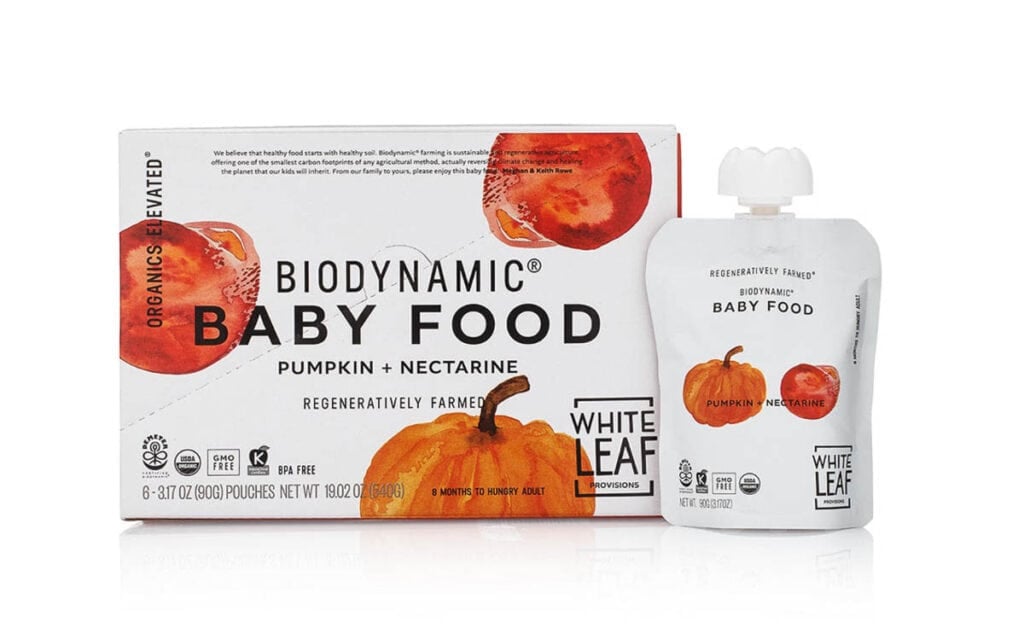
Why I Trust It: White Leaf Provisions is a family business run by a husband and wife team who were frustrated by the lack of transparency in baby food when their son was born. They created the first 100% regeneratively farmed, biodynamic, organic baby food line in the US.
Regenerative farming doesn’t just avoid harming the soil. It actively works to restore soil health and fertility. This matters for heavy metals because healthier soil naturally filters out contaminants better. When I interviewed the founders for my research, they explained how they test their soil regularly and work directly with farms to ensure the lowest possible heavy metal levels.
Most White Leaf pouches have less than 8 grams of sugar, and many have less than 6. The Organic Peas, Apples, and Cauliflower variety were one of my kids’ favorites because the peas give it a slightly savory taste that’s different from typical fruit-heavy pouches.
White Leaf also offers my readers 10% off with code “PICKYEATS” at checkout, which makes their premium pouches more affordable.
What I Buy And Recommend:
- Organic Pumpkin and Nectarine
- Organic Peach and Oat
- Organic Peas, Apples, and Cauliflower
- Organic Tomatoes, Fennel, and Spelt
Price: $20.75 for 6 pouches (or $3.46 per pouch) or subscribe and save for 10% off.
Where To Find It: Company Website, Amazon, and Whole Foods
International Options
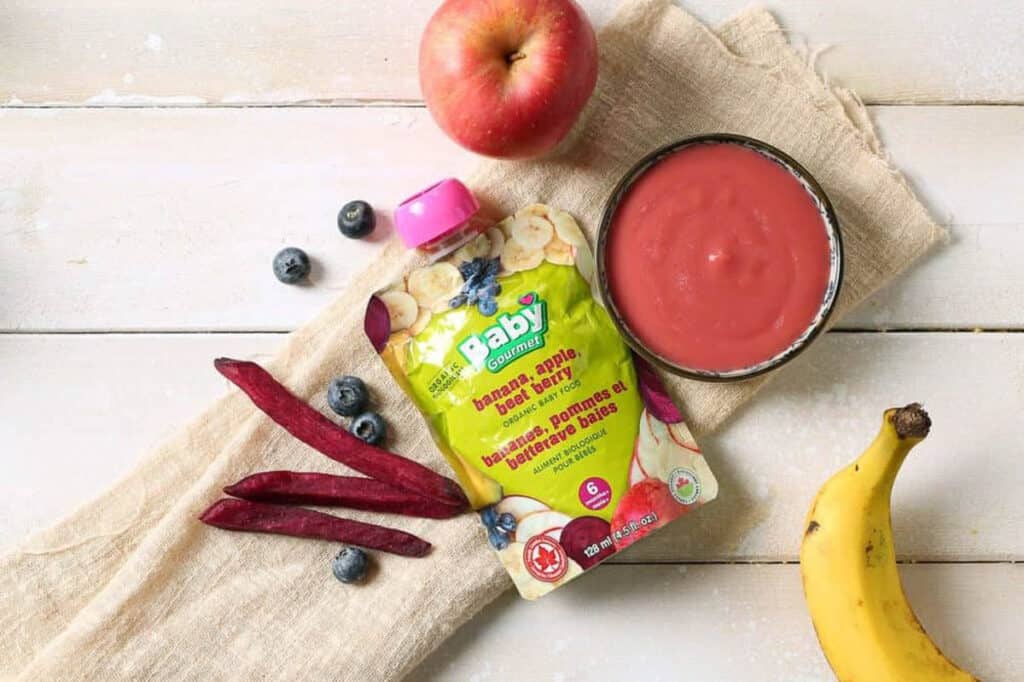
For Readers In Canada: Baby Gourmet offers some good varieties with lower sugar content. Their roasted squash and fruit medley has only 6 grams of sugar, and their savory meals are low in sugar too. Available through their company website and major Canadian grocery stores.
For Readers In Britain & Europe: Ella’s Kitchen Organic used to be available in the US but now only ships to Britain and the EU. They make high-quality organic pouches available through their company website.
Beyond Pouches: Other Safe Baby Food Options
If you’re looking for alternatives to traditional pouches, I’ve also tested several non-pouch brands that meet the same safety standards. These all use organic ingredients, have no added processed sugar, and are Clean Label Project certified.
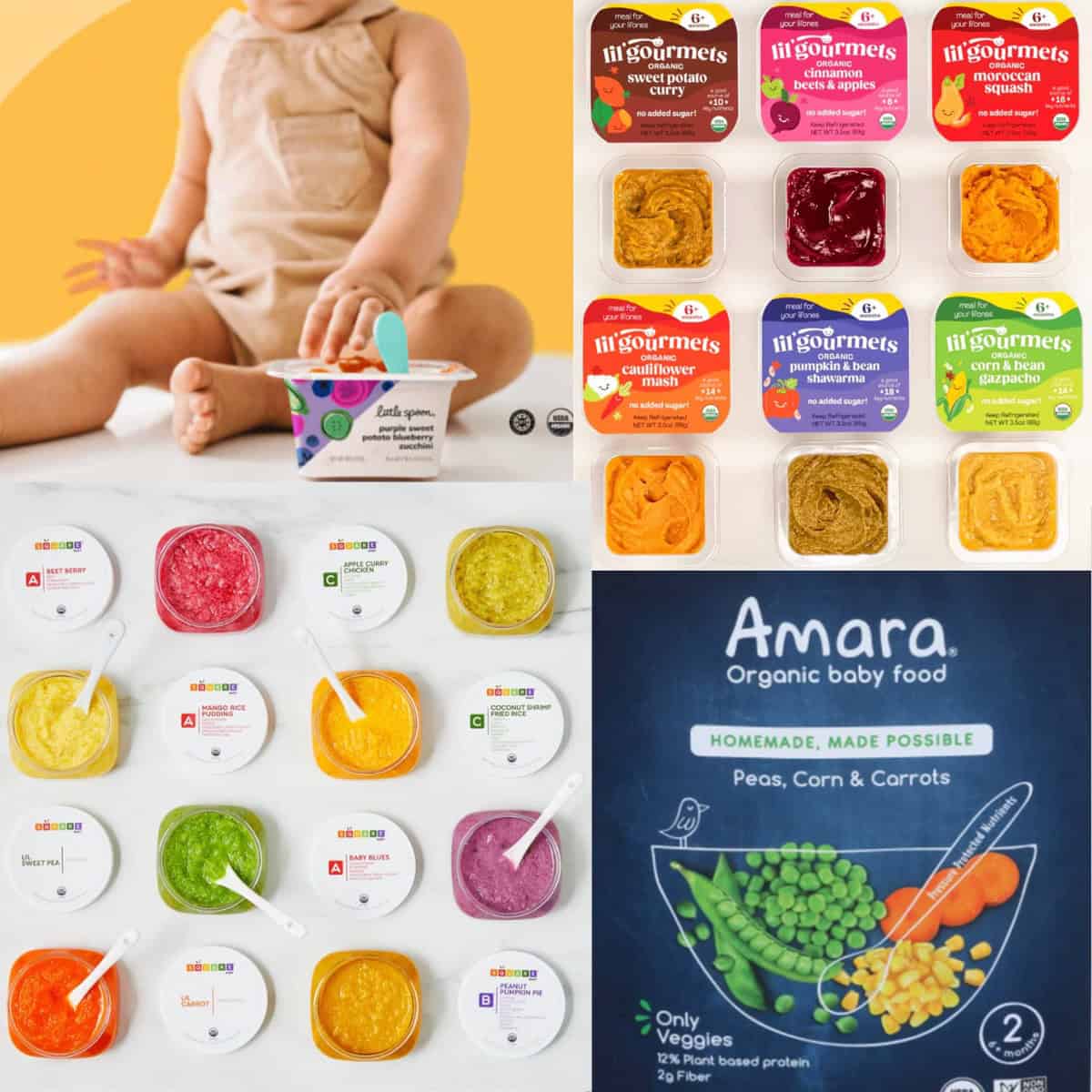
Amara Organic makes powdered baby food that you mix with water or milk. The powder format was perfect when we flew internationally because I could pack it in my carry-on without worrying about TSA liquid limits. It reconstitutes in 30 seconds and doesn’t use high-heat processing, so nutrients stay intact. My favorite varieties are Organic Peas, Corn, Carrots and Organic Black Bean and Sweet Corn. $59.99 for 20 pouches.
Little Spoon offers six progressive stages of fresh baby food cups with adventurous flavors like strawberry basil gazpacho and turmeric sweet potato bell pepper soup. This helped both my kids transition from smooth purees to chunkier foods. They are Clean Label certified and subscription-based (but easy to pause or cancel). Starting at $2.96 per cup.
Square Baby was created by a dietitian and offers complete nutrition meals with vegetables as the first ingredient. Each cup has half the sugar and twice the protein of average pouches. They also have an allergy introduction menu that I used to introduce peanuts, tree nuts, and sesame to my kids. Starts at $4.98 per meal.
Lil’ Gourmets features global flavors like pumpkin bean shawarma and sweet potato curry which I love! Each cup meets 100% of a baby’s daily veggie requirements. The flavors helped build my kids’ palates to accept the spices we use in our family cooking. This brand is also Clean Label certified and fresh (refrigerated). $33.50 for 8 cups.
Bonus tip: You can scoop any of these into reusable silicone pouches for portable meals without the waste of disposable pouches. I used to do this all the time when my kids were little!
The Heavy Metals Problem (What Every Parent Needs To Know)
When I first learned about heavy metals in baby food, I was definitely worried. How could something marketed as healthy and safe for babies contain toxic metals? Here’s what I learned after weeks of research.
Heavy metals like arsenic, lead, cadmium, and mercury get into baby food through the soil, which naturally contains heavy metals. Certain crops absorb these metals more readily, especially rice, carrots, and sweet potatoes.
Heavy metals are particularly harmful to babies and young children because their bodies are smaller and still developing. The metals can affect brain development, cognition, and behavior. Children also absorb metals more readily than adults do.
Until 2021-2022, baby food manufacturers weren’t regulated by the FDA for heavy metals. They set their own standards. It wasn’t until independent agencies like Consumer Reports and Clean Label Project started testing that parents even knew this was an issue.
The American Academy of Pediatrics recommends viewing this as a point of concern, not panic. They encourage parents to feed babies a wide variety of foods so they don’t consume elevated concentrations of metals from one source repeatedly. Heavy metals are in many foods (not just baby food), and total exposure matters more than any single meal.
Still, I wanted to minimize my kids’ exposure as much as possible. That’s why I only buy pouches that are Clean Label Project certified or Consumer Reports verified. These independent organizations test for heavy metals and hundreds of other contaminants.
Since then, the FDA launched the Closer to Zero Initiative to reduce heavy metals in baby food, and Congress has been pushing the Baby Food Safety Act. Progress has been slow, but at least there’s more awareness now than there was a few years ago. I tend to rely on 3rd party testing, which gives parents the information we need to make safer choices while we wait for better regulation.
How To Choose Safe Pouches (My Shopping Checklist)
After all my research, I created a simple checklist I use every time I buy pouches. Here’s what I look for:
1. Check for Clean Label Project certification. This icon on the package means the pouch passed testing for over 400 contaminants including heavy metals, pesticides, and chemicals. This is my #1 requirement.
2. Look at sugar content. I stick to pouches with 8 grams of sugar or less, but I prefer 4-6 grams. If a pouch has 13+ grams of sugar, and the first few ingredients on the label are fruit purees or fruit concentrates, I avoid those. 13+ grams of sugar is as much as a candy bar. My kids don’t need that, no matter how many vegetables are listed on the front.
3. Read the ingredients list. The first ingredient listed is what’s most abundant in the pouch. If the front says “spinach and apples” but apples are listed first, it’s basically an apple pouch with a tiny bit of spinach for marketing. I look for pouches where vegetables come first.
4. Choose all-vegetable pouches when possible. These are harder to find but worth seeking out. Cerebelly, Serenity Kids, Little Spoon, Lil’ Gourmets, and White Leaf Provisions all make excellent vegetable-only options.
5. Check fiber content. Fiber helps fill your baby up, aids digestion, and indicates the pouch contains whole foods rather than mostly water or fillers. If fiber is 1 gram or less, it’s probably watered down. I aim for 2+ grams of fiber per pouch.
6. Be cautious with high-risk ingredients. Pouches with rice, carrots, or sweet potatoes are most likely to contain heavy metals because these crops absorb metals from soil. I only buy these varieties if they’re Clean Label certified. Otherwise, I choose pouches with kale, spinach, peas, butternut squash, beans, avocado, or other ingredients not grown directly in soil.
7. Choose organic when possible. Organic pouches have lower pesticide exposure. If budget is tight, many companies offer 15% discounts for bulk orders or subscriptions. Once Upon a Farm is also WIC-approved now.
Brands I’m Cautious About
These brands fall in the middle, but in general I don’t recommend them – some are too high in fruits/sugars, others contain heavy metals or less-ideal ingredients. Some varieties might be okay, but I’d proceed carefully and read labels closely:
Peter Rabbit Organics (Pumpkin Tree): Not found to contain heavy metals, but made with more fruits than vegetables, resulting in high sugar content. Fine if nothing else is available, but not my go-to.
Kirkland Signature Organics (Costco): Organic and haven’t been found to contain heavy metals. However, they’re mostly fruit-based with around 10 grams of sugar per pouch. If you shop at Costco and want an affordable option, these are acceptable, but watch the sugar.
Little Journey (Aldi): Their pouches haven’t been found to contain high heavy metal levels, but their rice products have. I’d be selective about which products you buy from this brand.
Earth’s Best: Consumer Reports found concerning levels of lead in their Organic Sweet Potatoes. Because of this, many parents (including me) avoid this brand completely. If you do buy from them, skip anything with sweet potatoes, carrots, or rice.
Sprout Organics: Some of their products were listed by Consumer Reports as ones to reduce or avoid. Choose carefully if you purchase from them, and avoid pouches with sweet potatoes, carrots, or rice.
Happy Baby Organics (Happy Family): They claim to test every lot and seek farms with lower heavy metal soil levels. However, some products still showed concerning levels in 2023 testing. Their puffs particularly had high heavy metal profiles. Proceed with caution.
Brands I Avoid Completely
After reading the 2021 Congressional Report and reviewing Consumer Reports testing, these are brands I will not buy for my kids. Some refused to cooperate with heavy metal investigations, others knowingly sold contaminated products, and some have other quality issues that make me uncomfortable.
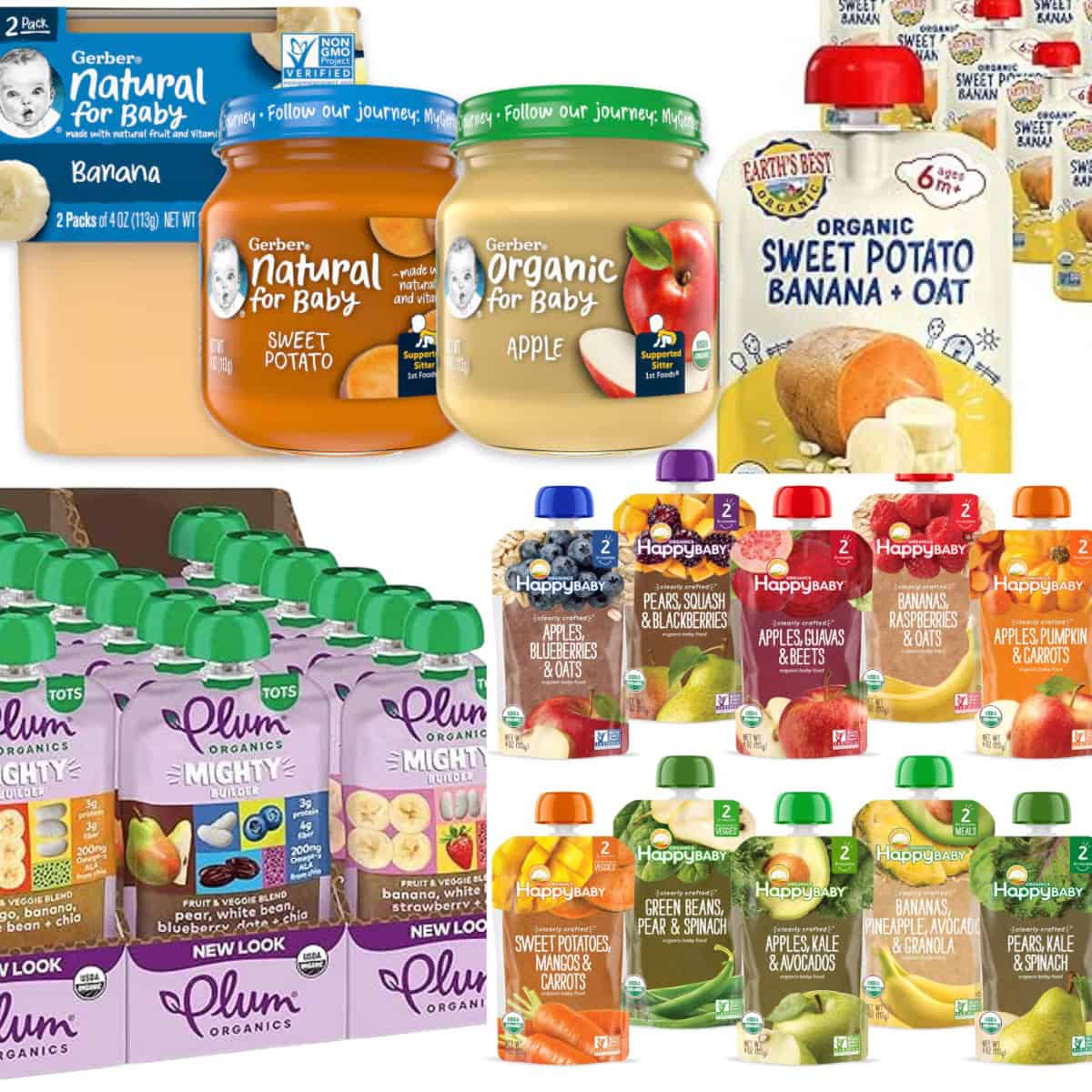
Plum Organics: This was one of the hardest brands for me to eliminate because my daughter loved their pouches when she was younger. But Plum refused to share heavy metal testing data when the Congressional Subcommittee requested it in 2019. That lack of transparency is a dealbreaker for me. When I looked closer at their ingredients, I noticed that many pouches are labeled as vegetable-forward but are actually high in sugar and made mostly with fruit.
Beech-Nut Naturals: The 2021 Congressional Report revealed that Beech-Nut’s internal testing found high levels of arsenic, lead, and cadmium in their ingredients, and they used those ingredients anyway. They sold products they knew were contaminated to babies. Even though they’ve eliminated rice products since then, some sweet potato varieties still tested high for heavy metals in 2023. I don’t trust a company that prioritized profits over children’s safety, so I avoid this brand entirely.
Gerber (Non-Organic): Gerber’s non-organic pouches automatically makes them concerning due to pesticide exposure. Their organic line showed relatively low heavy metal levels in the 2020 Congressional Report compared to other brands, but many varieties still contain concentrates instead of whole fruits (like banana concentrate rather than real bananas) and “vanilla flavor” instead of vanilla extract. I also don’t love that they tend to be high in sugar and fruit. If you do buy Gerber organic pouches, read labels carefully and stick to varieties with just fruits and vegetables listed.
GoGo squeeZ: Even GoGo squeeZ’s organic options contain fruit concentrates instead of real fruit, and some varieties even have added cane sugar. They also use rice flour, natural flavors, and pea protein isolate. The company makes no claims about heavy metal testing or purity, which is concerning. When I compared GoGo squeeZ to other brands, they consistently had the least whole-food ingredients and most processed additions. I skip these entirely.
Parent’s Choice (Walmart Brand): Parent’s Choice refused to cooperate with the 2019 heavy metal investigation. A 2021 lawsuit stated that the Congressional Subcommittee found their “lack of transparency greatly concerning, fearing that they might be obscuring the presence of higher levels of toxic heavy metals in their baby food products than their competitors’ products.” When a company won’t share safety data, I assume they’re hiding something problematic.
When To Start Pouches & How To Use Them
Your baby is ready for solid foods when they can sit up independently with good head and neck control. Once they reach this milestone and show interest in food by reaching for it or trying to grab yours, you can start offering solids. Most babies are ready around 6 months, though some may be ready as early as 4 months. Health experts recommend waiting until at least 4 months before introducing any solids.
You’ll know you made the right call when your baby swallows the food instead of spitting it back out with their tongue thrust reflex.
How I Introduced Pouches With Formula And Breast Milk
The phrase “food before one is just for fun” is actually a myth that recent research has debunked. Introducing food when your baby is developmentally ready supplies additional nutrition they need starting around 6 months, and it supports sensory and social development related to eating.
Recent research shows that babies introduced to more foods at 4 months and beyond tend to have wider and more balanced diets as they grow. Though your baby gets most nutrition from formula or breast milk before age 1, they’ll naturally increase solid food intake as they need more energy, and their formula or breast milk consumption will decrease on its own.
I started by offering solids once a day when both of my kids turned 5 months old, while keeping their breastmilk / formula schedule consistent. Slowly I worked in more solid feedings per day, either reducing the number bottles by one or keeping the same number of bottles but decreasing volume by an ounce or two per feeding. Or if I was breastfeeding, I let my babies guide the process themselves by unlatching when they were full.
Baby-Led Weaning vs. Spoon Feeding vs. Combination Feeding
There are two main approaches to introducing solids: baby-led weaning (offering whole finger foods from the first bite) and traditional weaning (spoon-feeding purees).
With baby-led weaning, babies pick up food by hand and feed themselves. The goal is for babies to self-regulate their eating and develop trust in their bodies.
With traditional spoon-feeding, parents spoon-feed purees to their child. This makes it easier to know how much your baby is eating, it’s more familiar for family and friends helping with feeding, and it’s less messy. However, babies don’t develop fine motor skills and pincer grasp as quickly, don’t learn to chew or build jaw strength, and don’t self-regulate their eating as much. (If you choose spoon-feeding, advance textures when your baby shows readiness to help develop these skills.)
I used a combination method with both kids. Some meals I offered finger foods and let them practice self-feeding. Other meals I squeezed pouches onto self-feeding spoons so they could practice bringing the spoon to their mouth while still getting the nutrition from purees. And other times I would spoon feed them myself, especially when I was trying to get them to try new foods. As my kids got older, they could also self-feed directly from pouches, which gave them independence while I cleaned up from dinner.
Experts say the method doesn’t matter as much as parents being relaxed so the eating environment is enjoyable for babies. Choose what feels comfortable for you and adjust as you go. I started with more spoon-feeding when both kids were 6 months old and gradually transitioned to more finger foods as they got better at picking up and chewing food.
If you’re interested in baby-led weaning, I have a whole guide to introducing solids with age-appropriate ideas and safety tips.
FAQs
Which baby food pouches are the healthiest?
The healthiest pouches are Clean Label certified or Consumer Reports verified, made with organic ingredients, low in sugar (6-8 grams or less), and feature vegetables as the first ingredient. Cerebelly, Serenity Kids, Once Upon a Farm, White Leaf Provisions, and Holle all meet these standards. I keep all five brands in my pantry and trust them for my own kids.
Are food pouches healthy for babies?
Yes, pouches can be healthy if they’re made with organic ingredients certified low in heavy metals and contain 6-8 grams of sugar or less. Ingredients grown in soil (carrots, sweet potatoes, rice) are more likely to have higher heavy metal levels. If buying a pouch with these ingredients, choose brands that are Clean Label certified. I’ve tested dozens of brands and found that the five I recommend above are the safest and most nutritious options available.
What baby pouches are being recalled?
At the time of publication, only WanaBana, Schnucks, and Weis brands of cinnamon applesauce pouches have been recalled. The FDA hasn’t recently recalled baby food pouches. All heavy metal reports come from Consumer Reports and Clean Label Project testing, not official recalls.
Which baby food does not have heavy metals?
Baby food certified by Clean Label Project Purity has been verified through third-party testing to be low in heavy metals and other contaminants. Brands that meet this standard include Serenity Kids, Cerebelly, Once Upon a Farm, Little Spoon, Square Baby, White Leaf Provisions, and Holle. These are the only pouches I buy for my kids.
Final Thoughts
I know the baby food aisle can feel overwhelming, and reports about heavy metals are genuinely scary. But I hope this guide helps you feel confident about finding safe options for your baby!
Even though some major baby food brands have serious problems, many high-quality companies have stepped up to fill the gap. Third-party testing from Clean Label Project gives parents the information we need to make informed decisions. The brands I’ve recommended here are the ones I trust enough to keep in my own pantry for both of my kids.
If you’ve recently discovered another Clean Label verified brand with 5 grams of sugar or less and vegetables as the first ingredient that isn’t on this list, please share it in the comments below. I’m always looking for new options to try with my kids.
And if you have questions about a specific pouch or any of the reports I mentioned, leave a comment or contact me here. I respond to every message I get!
Looking To Make Your Own Baby Food? Try My Top-Rated Baby Food Recipes!
- Avocado Puree
- Blueberry Baby Food
- Pear Puree Baby Food
- Zucchini Baby Food
- Green Bean Puree
- Pea Puree for Babies
More Baby Nutrition & Product Reviews
Looking for the best products and food for your baby? Read more of my “Best Of” posts below:
- Best Organic Baby Formula
- Best Vegan Baby Formula
- Best Toddler Formula
- The Best Multivitamins for Kids
- Best Baby Cereal Brands
- The Best Probiotics for Kids



This is such an amazingly clear and informative post. It was invaluable when researching healthy options for pouches I could buy on amazon ahead of a short weekend vacation. Thank you, thank you!
Thank you so much!! I’m so so glad this post was helpful for you! 🙂
Hi! For now, I’ve been making my baby’s food and I plan to continue , but as she grows, I know this will be tougher as she’s more on the go. I’d like to know, out of these pouches, which are the best ? I have not seen the Ella’s or the second one listed in stores, are they typically only available online?
Hi Emily! It’s great that you’re planning ahead! And honestly, all of the pouches on this list are pretty comparable (e.g. they’re all organic, low in sugar, etc). Most of them are only available online because even if a particular brand is available in grocery stores — the pouches most grocery stores carry are usually the sweeter ones that I wouldn’t recommend (e.g. more than 8g sugar per serving). So if you’re choosing between the pouches on this list, I’d go with the flavors your child is most likely to enjoy, and feel free to mix and match brands too — e.g. all of your pouches don’t have to come from just one brand since they are all pretty comparable! Hope that helps!
Hi, thank you for the list of healthy pouches. My husband has been making all of our daughter’s meals since she started solids at 6 months (just turned a year), but with his busy work schedule it is getting more difficult. One thing I noticed was that I give her beachnut oatmeal whole grain in the mornings sometimes…should I not be doing this? Also I have just started giving her stoneyfield organic kids yogurt, but just read it has 9g sugar….are these two bad options I’ve been filling my baby with?
Hi Sheryl! I’m so glad you found this post helpful! To your question — there’s a chance that the pre-made baby oatmeals have a higher amount of heavy metals than regular, organic rolled oats. So instead of using Beechnut’s oatmeal, I’d just recommend grinding up organic rolled oats yourself into a fine powder, and cooking that the way you would regular oatmeal for your daughter. For Stonyfield Organic Kids Yogurt – it depends on which one you’re using. Are you using the plain, whole milk kids yogurt? Or is it flavored (like strawberry, vanilla, blueberry, etc.)? If it’s flavored, I wouldn’t use it because the flavored varieties have a bunch of added sugar. If it’s plain organic whole milk yogurt, that’s totally fine – the sugar you see on the label will be the naturally occurring lactose found in milk and yogurt. So basically, for yogurt, plain and unflavored is the way to go. Hope that helps!
This is such great information! My baby is 4 months are starting foods soon and I’m excited to have more information to buy the best foods! I am curious if the gerber organic pouches are okay? I was checking all the requirements you listed and it seemed like some qualified. Could you give me some insight on those? Thank you:)
Hi Brit! I actually haven’t found any Gerber Organic pouches to be healthy enough — they either fall into one of two categories: 1) Has sweet potatoes or rice cereal or baby oatmeal added — all of which run the risk of heavy metal contamination or 2) Has 10g sugar or more per serving. I’d recommend one of the pouches on my list instead!
Thank you for clarifying:) I double checked and your right. Thanks for the wonderful list!
No problem at all! 🙂
Hi!
I noticed on the juice & Drinks Shopping List 5. Ella’s Kitchen Superr Sweet Potato + mango smoothie Drink
1st ingredient is apple then sweet potato
Sugar content is 9
This product is listed on your top 5 juice and drink list.
I’m confused I read to avoid sweet potato
Why is Apple first ingredient and thought best to avoid apple.
Hi Marie! Can you show me where you saw the Ella’s Kitchen Sweet Potato Mango Smoothie listed in my post? Because I just double checked and it’s not on my list of top baby food pouches. You are right that sweet potato is best to be avoided and if it’s more than 8g sugar you should also avoid it. Apple is totally fine to have in moderation though. Hope that helps!
I wanted to know if the fruits in Happy Baby baby food are mixed together or placed separately in the pouch/package on top of each other. I asked because I opened a pouch and each pureed fruit came out separately not mixed together.
Hi Marilyn! I think they are mixed together, but because there are no thickeners or emulsifiers added, they may separate in the package. I’d just squeeze the package around before you open it to help the purees mix if you notice that they have separated before giving it to your little one!
Are the glass jars of earths best and beech nut a good choice? Or does it have to be a pouch
It doesn’t have to be a pouch! You can certainly do the glass jars if they follow the guidelines I’ve outlined in this post!
Have you looked into Serenity Kids food pouches? None of them contain fruit, just curious what you think of them.
Hi Jackie! I hadn’t heard of them but their pouches look awesome!! I would totally recommend them and I’m adding them to my post now! 🙂
This is very helpful!
I recently took a CPR class and yogurt was mentioned as a choking hazard for babies and toddlers. I saw a message regarding the mention of better types of yogurt and thought I’d share that information with you if you want to check into it.
Hi Kristin! I’m curious how plain, whole milk yogurt is a choking hazard for toddlers and babies who are well into solids? Given how thin it is, I’d be surprised that it would be a choking hazard — so please send me the info you have at pickyeats@gmail.com. Thanks!
Hello-
I was wondering how is moms can see if a product has heavy metals in it? I didn’t even know about this and although i made all my daughters baby foods once she got a little older i would allow pitches and she loves the sweet potato one and I’m worried that she has been ingesting heavy metals for some time! Ugh. What on the label would show this?
Hi Jessica! That’s a great question! Unfortunately, there is no way for parents to know whether a particular pouch has heavy metals in it or not – it’s not indicated anywhere on the label! Isn’t that crazy? Instead, I’d recommend avoiding pouches that have foods likely to have heavy metal contamination — mainly: anything with rice, anything with other baby cereals – e.g. oatmeal/rice cereal/etc. and anything with sweet potatoes. If you do that you should be able to avoid the concerning levels of heavy metals in baby food! Hope that helps!
I read that using store bought baby oatmeal isn’t a good idea. How can you make your own baby oatmeal? And can you recommend a good oatmeal to use?
Hi Emily! I agree, I wouldn’t use store bought baby oatmeal. I would recommend just grinding up these organic rolled oats in a food processor to make an “oat flour” and then cooking it the way you would regular oats (e.g. 1 cup ground rolled oats + 2 cups water cooked in the microwave or on the stove top). Hope that helps, let me know if you have any other questions!
Hi Anjali
Great article. Your content is damn useful and handy. I am a new mom who just started organic single grain oat cereal for my little one. She is just 5 months old. As right now pediatrician recommended to introduce one new food in every 3-4 days so I am trying to stick to homemade food. Due to some unavoidable reasons I am travelling to India next week. Is there anything stage 1 purees you can recommend which I can carry for my trip? I will try to cook but would need a backup
Hi Sunila! Here are some of the Stage 1 pouches I’d recommend:
Beechnut Peas & Spinach
Beechnut Peas, Green Bean and Avocado
Amara – Bean and Sweet Corn
Amara – Peas, Corn, Carrots
Sprout – Green bean, peas, butternut squash
HF – Green Beans, Spinach, and Pears
EB – Carrots & Broccoli
WLP – Carrot, Sweet Potato, Pea
Hope that helps and hope you have a great trip!
Hi, what about the love child brand? Is it also ok?
Hi Myriam! I was only looking at Baby Food Pouches that are available in the US so I actually hadn’t heard of Love Child Organics since they are not available in the US — it looks like they’re only available in Canada! Most of their pouches are way too high in sugar, but there are a few pouches that I’d recommend: Kale, Peas and Pears; veggie casserole with lentils + quinoa, ratatouille with lentils + white beans, vegetarian chili with sweet potato + kale, pumpkin risotto with spinach + chickpeas, thanksgiving dinner, mango chicken stew, hearty bolognese. Any of those would be a good choice!
Hello! Your articles are very helpful. Wondering if you have heard of the company Little Spoon? I’m getting ready to start baby food; took notes on some of the options you’ve recommended here but was considering ordering from them as well. I’d love to start making it as well but definitely need a convenient option to supplement.
Hi Stephanie!! I actually hadn’t heard of Little Spoon before you mentioned it, but I looked them up and they look amazing! I would still watch for the sugar content when ordering their purees, because not all of their purees have 8g sugar or less. But I love that it’s fresh, organic and all of their veggie purees (like the broccoli/spinach one) are JUST veggies! That is fantastic! Hope that helps, let me know if you have any other questions!
Hello There! So all of the pouches on this list have been researched for heavy metal levels? I was so upset when I read that was a problem, but I have not been able to find a “safe” list ANYWHERE so I have been struggling
Hi Kaitlin! Consumer Reports actually had a great list, and so I used their research when developing my list (so any pouches that Consumer Reports called out as having a risk of heavy metals won’t appear on this list!) In general, sweet potatoes were a big culprit, which is why most of the pouches on my list don’t have sweet potatoes. Hope that helps, let me know if you have any other questions!
Thank you so much for this list!! I was wondering if you have you looked into the Parent’s Choice brand (Walmart) organic pouches? The butternut squash and carrots, zucchini & broccoli pouches seem to fit all your criteria. There’s other pouches like the green bean medley that match the criteria except that I don’t see fiber listed, so I assume there is no fiber. What do you think?
Hi Elvina! I didn’t know that Walmart had an organic pouch brand! So yes! The Butternut squash, root veggies + apples, carrot/zucchini/broccoli, and green beans all would fit the criteria of my list! To your question – the green beans looks like it has 2g fiber – so that actually looks fine to me! Hope that helps, let me know if you have any other questions!
Hey Anjali! Thanks so much for this post – even though I try to use your book as much as possible to make homemade food, I often don’t have time to cook and get so frustrated that most commercial baby foods are so fruit and sugar heavy! So being able to know beforehand which items are lower in sugar is a big help :). However, I noticed that Earth’s Best Organics wasn’t on the list, although I’ve found that their veggie and protein line of foods is pretty low in sugar. So I was just wondering if there was a reason they didn’t make this list. Thanks!
Hi Malavika! Great question!! Actually – Earth’s Best has some great options and I’ve updated my post to include them! The reason they weren’t included before was just because most of their healthy options are jars (they only have 2 healthy pouches) and I was looking at pouches only — but now my list is updated to include the jars from Earth’s Best as well! Hope that helps, let me know if you have any other questions!
Hi Anjali,
So when babies start taking solids, they go through a bit of constipation. Pediatricians suggest to take any fruit purées that start with the letter P, like for eg. pear, prunes etc. On the run or while traveling if I have to purchase from the store any of these which brand or brands would you suggest?
Hi Krithika! I love this pack of Baby Prunes from Plum Organics. It doesn’t have any other fruits added and it is SUPER effective at alleviating constipation – I used it for both of my kids and even used it for my daughter when she was 3 and had a bit of constipation while potty training! That’s the one I’d recommend – you can just buy it in advance and keep it on hand in case you ever need to use it. If you need to mix it with pears (since some babies don’t like the taste of just prunes) – I like this pouch from Mama Bear Organics. I haven’t personally used that brand but I know a lot of moms like it and the ingredients are good! Hope that helps!
Thanks Anjali! I’ll definitely try them for my baby 🙂
Awesome!! So glad it was helpful!
Thank you for all your helpful baby posts Anjali! Your site has been a great resource for me as a first-time mom. I’ve especially enjoyed your posts about essential baby gear and helping baby sleep.
Hi Amry! Oh yay! I’m so happy to hear that this post and the others have been helpful to you! I know how overwhelming it can be when you’re a first-time mom (I was certainly overwhelmed when my daughter was born!) So anything I can do to alleviate some of that is what I try to do! 🙂 Thanks for letting me know!
Thank you Anjali for this super informative post. I’m a new mom n have just started my baby on solids and I always wondered which among the organic products would be the best. I’ve been trying my best to prep everything at home, but like you said, there are times when traveling we need an alternative.
Anjali, What is your opinion on multi grain cereals for babies?
Hi Soumya! Thanks so much!! I was in the same boat as you – I made most food at home but sometimes you really just need an on-the-go option (travel is a great example!) So I’m so glad this post was helpful for you! As for baby cereals, I really like Holle Oatmeal the best because it’s all natural and has no additives or fillers. You can also just take rolled oats, grind them up in a food processor and cook them the way you would cook regular oatmeal! Let me know if you have any other questions!
Thank you Anjali for the response. I had bought Earth’s Best Oats n using it now. I also saw the multi grain cereal in the aisle. If oats alone along with other fruits n veggies works, then I guess I will go that way.
Also, by when can I start on a combination of 3+ fruits n veggies?
Your blog has been an eye opener for me personally in a lot of areas. Thank you so much n hats off for the efforts n time you put in to write specially with young kids.
Hi Soumya! Earth’s Best Organic in general is a decent brand but their baby oatmeal ended up testing high for heavy metals (based on a consumer reports study) so if you can switch to something else I would! And you can do combinations of 3+ veggies as soon as your little one has had exposure to them – so that way you know your baby isn’t allergic to any of the veggies or fruits in the combination! Hope that helps and happy to answer any other questions you might have!
Thank you very much Anjali. Really appreciate it.
Anytime!