
Best Fiber Supplements for Kids (2026 Guide)
This post may contain affiliate links. As an Amazon Associate, I earn from qualifying purchases. Please read my disclosure.As a health coach and mom of two, fiber is one of the questions I get asked about most, usually from parents whose kids fight every vegetable or struggle with uncomfortable, irregular tummies. So I spent 50+ hours digging through supplement facts panels, third-party testing standards, and more than a dozen products to find the ones I would actually give my own kids. In this guide, I’m sharing the best fiber supplements for kids in 2026, what to look for, what to avoid, and the clean picks that finally earned my recommendation.
After spending years helping parents navigate the overwhelming world of kids’ supplements, fiber is one I always talk about, because getting enough fiber is so important for overall health!
Most kids in the US fall short of their daily fiber needs. Depending on their age, children need roughly 19 to 38 grams of fiber per day, yet the average American child gets only about half of that. The result? Digestive discomfort, irregular bowel movements, and a gut microbiome that is not getting the nourishment it needs to support immunity, mood, and overall health.
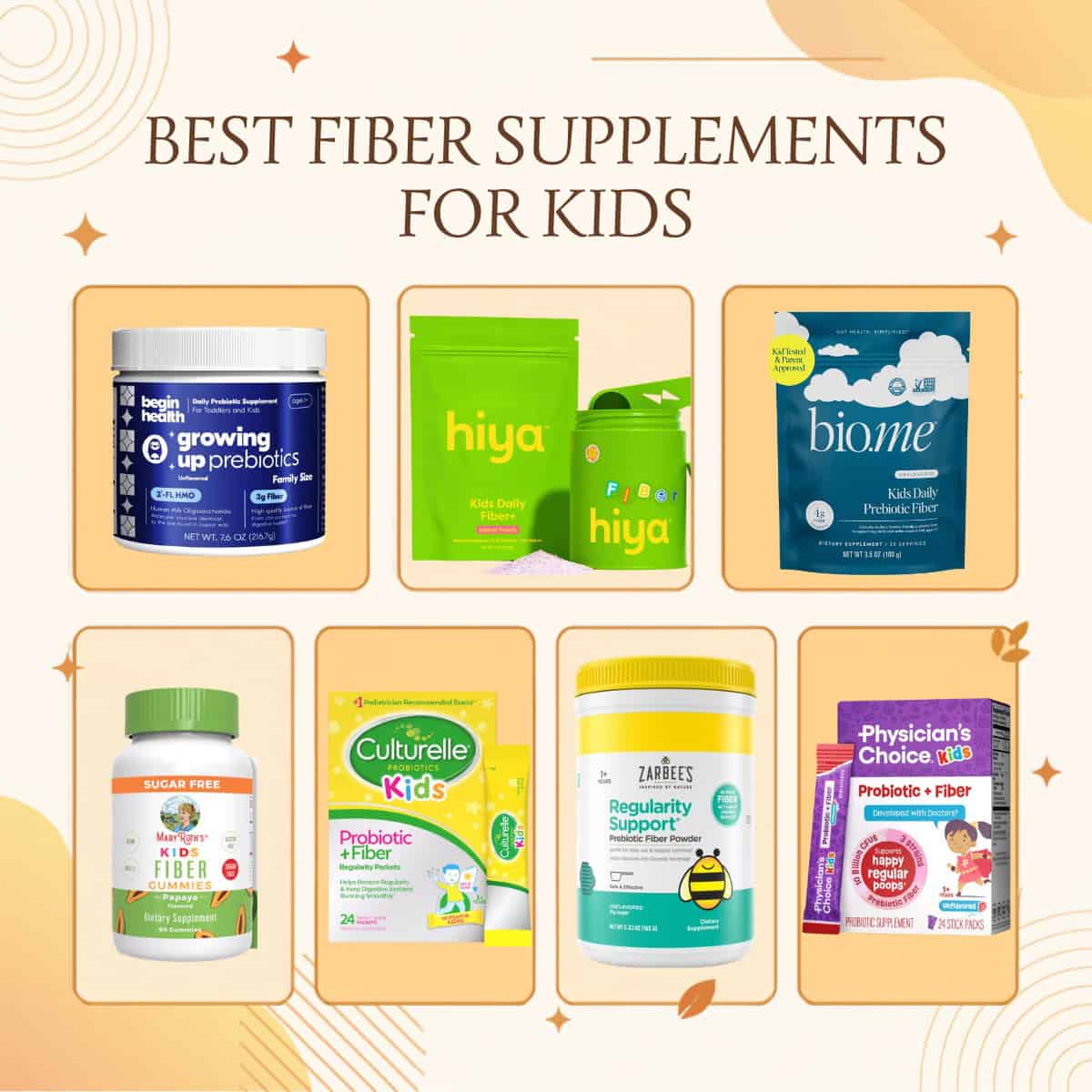
That is where a high-quality fiber supplement can help fill the gap, but finding the right one is harder than it should be. Many kids’ fiber products are gummies loaded with added sugar, artificial dyes, and minimal amounts of actual fiber. Which is where this guide comes in! I have done all of the research so you don’t have to – and I’ve narrowed it down to these 7 best options available today.
Table of Contents
hide
Top Picks: Best Fiber Supplements For Kids
Here’s a quick look at my top picks for different needs:
- Best Overall (Kids Age 2+): Hiya Kids Daily Fiber+
- Best For Sensitive Tummies: bio.me Kids Daily Prebiotic Fiber
- Best For 1-2 Year Olds: Begin Health Growing Up Prebiotics
- Best Fiber + Probiotic Combo: Culturelle Kids Probiotic + Fiber Packets
- Best Budget: Zarbee’s Children’s Regularity Support Prebiotic Fiber Powder
- Best Probiotic + Prebiotic + Fiber: Physician’s Choice Kids Fiber Packets
- Best Gummy: MaryRuth’s Kids Fiber Gummies
Disclaimer & Methodology
I’m a board-certified health coach and nutritionist, but I’m not a medical doctor. This post is based on 50+ hours of research, consultations with pediatric experts, going through peer-reviewed studies, and personal experience with my own children, but it’s for informational purposes only and shouldn’t replace advice from your pediatrician.
Every child is different. Always consult your healthcare provider before starting a new supplement, especially if your child has allergies, digestive issues, or special medical needs.
This post contains affiliate links, which means I may earn a small commission if you purchase through my links at no extra cost to you. I only recommend products I’ve researched, evaluated, and would feel comfortable giving to my own children.
Why Do Kids Need Fiber?
Fiber is one of the most underrated nutrients in a child’s diet. It does so much more than just “keep things moving.” Here’s what dietary fiber actually does for growing bodies:
- Supports healthy digestion and regular bowel movements
- Feeds the beneficial bacteria in the gut (the microbiome), which supports immunity
- Helps stabilize blood sugar levels
- Promotes feelings of fullness and satiety
- Reduces inflammation in the digestive tract
- Supports healthy cholesterol levels, even in childhood
There are two types of fiber, and kids benefit from both. Soluble fiber dissolves in water and forms a gel-like substance that slows digestion and feeds good gut bacteria (e.g. inulin, psyllium, guar gum, and FOS). Insoluble fiber does not dissolve. It adds bulk to stool and helps food pass through the digestive tract more quickly. The best fiber supplements for kids include a blend of both.
How Much Fiber Do Kids Need?
General daily fiber guidelines vary by age, but a good rule of thumb is to add 5 to your child’s age and that’s the minimum amount of fiber they need. However, the American Heart Association encourages a higher goal so that your child can get the maximum benefits fiber provides. Here are their guidelines:
- Ages 1 to 3: 19 grams/day
- Ages 4 to 8: 25 grams/day
- Ages 9 to 13 (girls): 26 grams/day
- Ages 9 to 13 (boys): 31 grams/day
- Ages 14 to 18 (girls): 26 grams/day
- Ages 14 to 18 (boys): 38 grams/day
The truth is, most kids are not hitting these targets, especially picky eaters. Fiber supplements can help bridge the gap, but they work best alongside a diet that includes plenty of fruits, vegetables, whole grains, and legumes.
What To Look For
Through my research, I came up with this guide for how to choose a fiber supplement for your child. Here’s my list of what matters most:
✅ Zero or minimal added sugar. Many fiber supplements, especially gummies, contain too much added sugar. I look for products sweetened with monk fruit, stevia, or allulose, or no sweetener at all.
✅ High-quality fiber sources. Not all fiber is created equal. I prefer products that use a blend of fiber types (prebiotic plus soluble plus insoluble) because they address gut health from multiple angles. But a single, well-studied, gentle fiber can also be the right call for a sensitive tummy.
✅ Third-party testing. Supplements are not regulated the same way medications are by the FDA. I strongly recommend choosing products that are independently tested by a third party (like NSF International, USP, or Clean Label Project) to verify that what’s on the label is actually in the bottle, and that the product is free from contaminants and heavy metals.
✅ Form factor. I prioritize powders and chewables over gummies. Gummies often require added binders, gelling agents, and added sugar, and they tend to deliver less fiber per serving. If you do go with a gummy, choose one carefully.
✅ Clean ingredients. No artificial colors, flavors, preservatives, or fillers.
✅ Age-appropriate dosing. I always check the label carefully for the recommended age range and dose.
What To Avoid In Kids’ Fiber Supplements
- Added sugar (many gummies have 2 to 4 grams per serving)
- Artificial sweeteners (like sucralose or aspartame)
- Artificial colors (Red 40, Yellow 5, Blue 1, etc.)
- Artificial flavors
- Fillers and unnecessary additives (carrageenan, high-fructose corn syrup, hydrogenated oils)
- Single-source, low-quality fiber that does nothing for the microbiome
- No third-party testing
Types Of Fiber: What’s the Difference?
Like I mentioned earlier, not all fiber is the same! Understanding fiber types helps you choose the right supplement for your child’s needs:
Prebiotic fiber (inulin, FOS, HMOs): Acts as food for the beneficial bacteria in the gut, so it’s great for microbiome health and immunity. Inulin is derived from chicory root and is one of the most well-researched prebiotic fibers. HMOs (human milk oligosaccharides) are a special class of prebiotics originally found in breast milk, now available in supplement form, and can work well for very young children.
Psyllium husk: A soluble fiber that forms a thick gel in the digestive tract. Helps to promote regularity and soften stools.
Partially hydrolyzed guar gum (PHGG): A gentle, soluble prebiotic fiber made from guar beans. It is tasteless and low-FODMAP, which makes it one of the easiest fibers on sensitive tummies. It feeds good bacteria and supports regularity without the gas and bloating that some higher-fermentation fibers can cause.
Acacia (gum arabic): Another soluble prebiotic fiber that ferments slowly and gently, often paired with PHGG for daily, low-discomfort use.
Resistant starch / resistant vegetable fiber: A unique type of fiber that “resists” digestion in the small intestine and ferments in the colon, feeding good bacteria and supporting bowel regularity.
Dragon fruit fiber: A natural source of both soluble and insoluble fiber, with the added bonus of antioxidants.
The 7 Best Fiber Supplements For Kids
I evaluated every product on this list based on ingredient quality, fiber type and diversity, third-party testing, form factor, sugar content, and overall value. Here are my top picks, starting with the best.
Hiya Kids Daily Fiber+ (Best Overall)
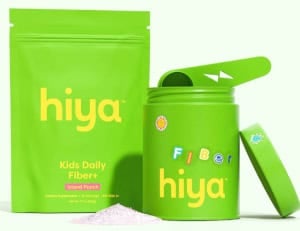
Why I Love It: Hiya is my top pick, and it’s not even close. This is the only kids’ fiber supplement I have found that checks every single box: zero added sugar, a multi-fiber blend using four distinct fiber sources, third-party testing with Clean Label Project certification, and a powder format that’s easy to mix into water or juice. It was formulated with pediatricians specifically for children, and it shows.
What really sets Hiya apart is its fiber diversity. Rather than relying on a single fiber source, Hiya combines organic inulin (prebiotic), psyllium husk (soluble), resistant vegetable fiber (insoluble), and dragon fruit (natural fiber plus antioxidants). This means it supports gut bacteria, regularity, and overall digestive health all at once.
Hiya sweetens its blend with monk fruit and allulose, two zero-glycemic sweeteners that provide real sweetness without any blood sugar impact. The Island Punch flavor is genuinely delicious – my kids love it, and honestly I thought it tasted great too, and it mixes easily into water or juice. There is no graininess, chalky residue, no clumps, and no gritty texture.
It’s also one of the few products on this list that carries Clean Label Project certification, which means it has been independently tested not just for accuracy of the label, but for the presence of heavy metals, pesticides, and other harmful contaminants. That level of verification matters to me because it’s a product I’m giving to my kids, so I want to make sure it’s safe.
Form: Powder (mixes into 4 to 6 oz water or juice)
Price: $58 for a 30-day supply, but you can get your first month at 50% off so it’s just $29 (subscription only)
Age: 2 to 12 years
Fiber per serving: 3g per scoop
Fiber sources: Organic inulin, psyllium husk, resistant vegetable fiber, dragon fruit
Sweetener: Monk fruit + allulose (zero sugar)
Pros
Zero added sugar
4-fiber blend for comprehensive gut support
Clean Label Purity Project Certified
Third-party tested for heavy metals and contaminants
Delicious Island Punch flavor kids love
Non-GMO, vegan, gluten-free, dairy-free
No artificial ingredients of any kind
Cons
Only available via subscription on Hiya’s website
Not for children under 2
Higher price point than some of the other options on this list
bio.me Kids Daily Prebiotic Fiber (Best for Sensitive Tummies)
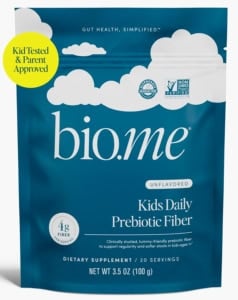
Why I Love It: If your child has a sensitive stomach, gets gassy or bloated easily, or you are just nervous about introducing a new fiber, bio.me is the gentlest option I have found. It’s built around partially hydrolyzed guar gum (PHGG), a soluble prebiotic fiber that is tasteless, colorless, and low-FODMAP, so it tends to be very easy on little digestive systems.
What I appreciate most is how clean and simple it is. The unflavored version for ages 1 and up is a single, well-studied fiber, which keeps the ingredient list short and makes it easy to stir into water, smoothies, yogurt, or even mac and cheese without changing the taste. For kids 4 and up, there are naturally flavored options too, but the core fiber stays the same.
On the quality front, bio.me is non-GMO, gluten-free, dairy-free, vegan, third-party tested, and certified glyphosate residue free. The reason it sits at #2 rather than #1 is fiber diversity: it’s a single-source fiber, so it doesn’t offer the coverage that Hiya’s blend does. But for gentle, daily support, it’s a great choice, and the age 1+ option makes it one of the few that I’m comfortable recommending for toddlers.
Form: Powder (mixes into food or drink)
Price: Around $24.99
Age: 1 year and up (unflavored); flavored options for 4+
Fiber per serving: 4g
Fiber source: PHGG (partially hydrolyzed guar gum)
Sweetener: None (unflavored), Stevia (flavored)
Pros
Zero added sugar
Gentle, low-FODMAP fiber that is easy on sensitive tummies
Unflavored and tasteless, great for picky eaters
Third-party tested and certified glyphosate residue free
Safe for ages 1+
Non-GMO, vegan, gluten-free, dairy-free
Cons
Single-source fiber (not a multi-fiber blend)
Made in a facility that processes major allergens
Only available online
Begin Health Growing Up Prebiotics (Best For 1-2 Year Olds)
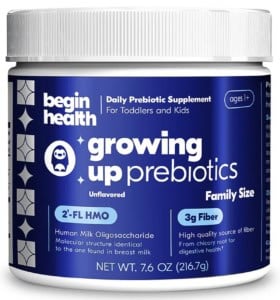
Why I Love It: Begin Health is a premium, pediatrician-developed powder that earns its spot because it uses HMOs (human milk oligosaccharides), a prebiotic fiber originally found in breast milk and one of the most gut-microbiome-supportive ingredients you can give a young child.
Combined with 3 grams of chicory root prebiotic fiber per serving, Begin Health is great for toddlers and young children whose gut microbiomes are still developing. It’s unflavored, mixes easily into food or drinks, and contains no added sugar.
So why is it at #3 instead of higher? Primarily because of price. At around $39.95 for 28 servings, it’s one of the most expensive option on this list on a per-serving basis. It’s also a single-focus prebiotic supplement (HMOs plus chicory root fiber) rather than the comprehensive multi-fiber blend that Hiya offers.
One thing worth flagging for allergy-conscious parents: because lactose is used as a starting ingredient in the HMO fermentation process, the label states “contains milk,” even though only a trace amount remains. If your child has a milk allergy, check with your pediatrician first. For parents specifically focused on early gut microbiome development in toddlers, though, Begin Health is an excellent, science-backed choice.
Form: Unflavored powder
Price: $39.95 for 28 servings (less on subscription)
Age: 1 year and up
Fiber per serving: 3g
Fiber source: 2′-FL HMO + chicory root prebiotic fiber
Sweetener: None
Pros
Contains HMOs, a premium prebiotic from breast milk research
Zero added sugar
Unflavored, mixes invisibly into food
Specifically designed for developing gut microbiomes
Pediatrician developed
Cons
More expensive than most other options
Not a multi-source fiber blend like Hiya
Label states “contains milk” (trace amount)
Culturelle Kids Probiotic + Fiber Packets (Best Fiber + Probiotic Combo)
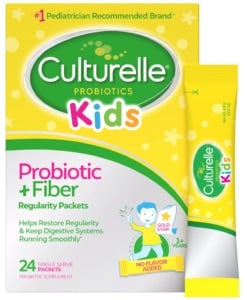
Why I Love It: Culturelle’s fiber packets earn their spot because they do something unique: they combine a well-researched probiotic strain (Lactobacillus rhamnosus GG, 2.5 billion CFUs) with 3.5 grams of fiber from natural wheat, fruit, and vegetable sources. If your child struggles with both irregularity and gut bacterial balance, which is very common after antibiotics or illness, this two-in-one approach is really smart.
The packets are completely unflavored, which is a huge win for picky eaters. They mix invisibly into yogurt, applesauce, or juice, and kids really won’t be able to tell that this fiber packet is mixed into their food. There is no added sugar, no artificial dyes, and no artificial flavors, and the product is non-GMO.
Why isn’t Culturelle higher on the list? It lacks the fiber diversity of Hiya, and the fiber is sourced partly from wheat, so it is not the best fit for kids with a wheat or gluten sensitivity (the brand processes it to be gluten-free, but I would still check with your pediatrician if that is a concern). For parents who want a daily fiber plus probiotic combo without any taste battle, this is a fantastic pick.
Form: Unflavored dissolvable powder packets
Price: $19.47 for 24 packets
Age: 1 year and up (per manufacturer; some retailers list 3+)
Fiber per serving: 3.5g
Fiber source: Wheat, fruit, and vegetable fiber
Sweetener: None
Pros
Zero added sugar and completely unflavored
Combines fiber + clinically studied probiotic
Great for ages 1+ and toddlers
Non-GMO, no artificial dyes or flavors
Mixes invisibly into food, great for picky eaters
Cons
Contains wheat-derived fiber
Not a multi-fiber blend
Zarbee’s Children’s Regularity Support Fiber Powder (Best Budget)
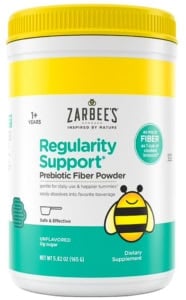
Why I Love It: If you want something clean that’s budget-friendly, and that you can grab at almost any drugstore or big-box store without ordering online, Zarbee’s is my pick. It uses a gentle two-fiber prebiotic blend of Sunfiber (PHGG) and organic gum acacia, delivers a solid 6g of fiber per serving, and has 0g of sugar with no artificial sweeteners, no artificial flavors, and no dyes.
The powder is flavorless and dissolves easily into foods or drinks, and the ingredients are low-FODMAP certified, so it’s gentle for daily use, and can be used for kids age 1+.
The reason Zarbee’s lands at #5 rather than higher is testing transparency. It’s a clean, well-trusted brand, but it doesn’t carry the same Clean Label Project certification or publicly documented third-party heavy-metal testing as my top picks do. Still, for an affordable, genuinely clean fiber powder you can buy in person today, this is the easiest one to recommend.
Form: Powder
Price: About $19 for a 5.82 oz tub
Age: 1 to 12 years
Fiber per serving: 6g
Fiber source: Sunfiber (PHGG) + organic gum acacia
Sweetener: None (0g sugar)
Pros
6g of fiber per serving
0g sugar, no artificial sweeteners, flavors, or dyes
Gentle, low-FODMAP certified
Widely available at drugstores and big-box stores
Affordable
Flavorless, mixes into food, ages 1 to 12
Cons
Third-party testing less publicly documented than top picks
Single-category (soluble) prebiotic blend
Physician’s Choice Kids Fiber Packets (Best Probiotic + Prebiotic + Fiber)
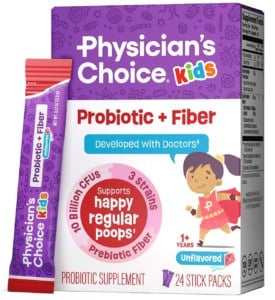
Why I Love It: Physician’s Choice rounds out the powders as a clean, affordable option that does double duty. Each unflavored stick pack combines prebiotic fiber with three probiotic strains, including Lactobacillus rhamnosus GG, the most clinically studied probiotic strain in children. It’s formulated without major allergens, sugar, GMOs, preservatives, or artificial ingredients, and it’s third-party tested in a cGMP facility.
It’s great for picky eaters since it can be stirred into basically anything, it’s recommended for ages 1+, so it’s toddler-friendly too.
It sits at #6 mainly because it is a newer, less established name in the kids’ space compared to the brands above it, and like Culturelle it’s a combo product rather than a dedicated multi-fiber blend. But if you want clean, allergen-friendly, third-party-tested support at a wallet-friendly price, it’s a strong value.
Form: Unflavored powder stick packs
Price: $23.97 for 24 packets
Age: 1 year and up
Fiber source: Plant-based prebiotic fiber
Sweetener: None (no added sugar)
Pros
No added sugar, no major allergens
No GMOs, preservatives, or artificial ingredients
Combines fiber + 3 probiotic strains
Third-party tested, cGMP facility
Unflavored, great for picky eaters, ages 1+
Budget-friendly
Cons
Newer, less established brand in the kids’ category
Doesn’t have a multi-fiber blend
MaryRuth’s Kids Fiber Gummies (Best Gummy)
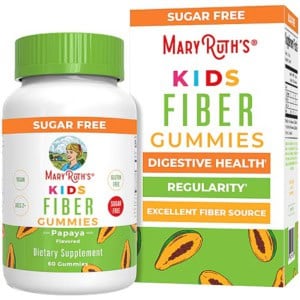
Why I Love This: If you have tried everything and your child simply refuses powders, MaryRuth’s Kids Fiber Gummies are the cleanest gummy I have found. They deliver 3 grams of soluble fiber per gummy, are pectin-based (so no gelatin, making them vegan), and are sweetened without any added cane sugar. They are also Clean Label Project certified and made by a B Corp, which is rare in the gummy category.
These papaya-flavored gummies skip the artificial colors and flavors you will find in a lot of drugstore gummies, using fruit and plant-based colors instead. Each bottle is a two-month supply at one gummy a day, which makes them a good value, and they are non-GMO, dairy-free, nut-free, gluten-free, soy-free, and corn-free.
So why are gummies last? Form factor. Gummies inherently deliver less fiber per serving than powders and require gelling agents to hold their shape. MaryRuth’s uses maltitol (a sugar alcohol) to keep them sugar-free, which is cleaner than added sugar but can cause gas or loose stools in sensitive kids, especially if they eat more than the recommended serving. The fiber is also single-source rather than a blend. But for families where a gummy is the only format that works, this is the one I would reach for.
Form: Gummies
Price: $24.96 for a 60 day supply
Age: 4 years and up
Fiber per serving: 3g
Fiber source: Soluble tapioca fiber
Sweetener: Maltitol + organic stevia (no added cane sugar)
Pros
No added sugar
Clean Label Project certified, B Corp
No artificial colors or flavors
No gelatin (vegan friendly)
Two-month supply, good value, affordable
Non-GMO and free from top allergens
Cons
Gummy format, lower fiber per serving than powders
Uses maltitol (sugar alcohol), may cause GI upset in sensitive kids
Single-source fiber
Gummies can stick to teeth
Not for toddlers, for kids age 4+
Fiber-Rich Foods for Kids (Always Start Here!)
Supplements are helpful, but real food should always come first. I try to work these fiber-rich foods into my kids’ diets every day:
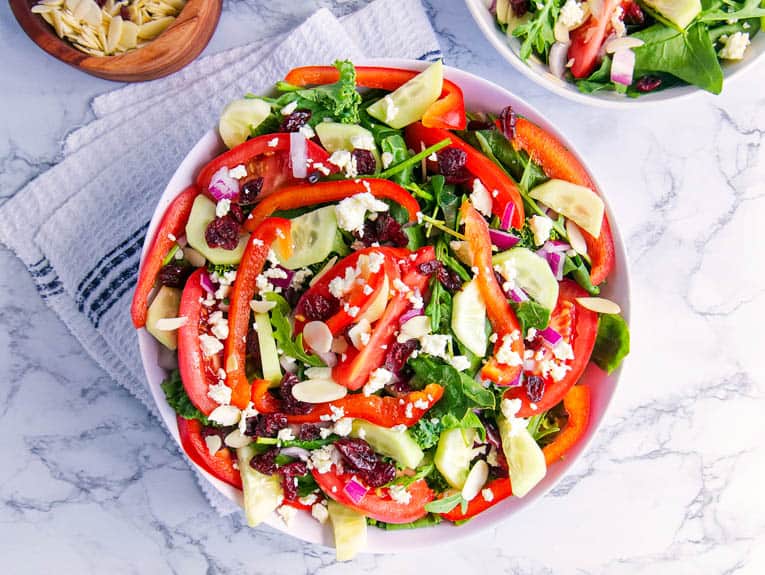
- Fruits: Apples (with skin), pears, raspberries, blackberries, strawberries, oranges, bananas (especially slightly under-ripe, since they contain resistant starch)
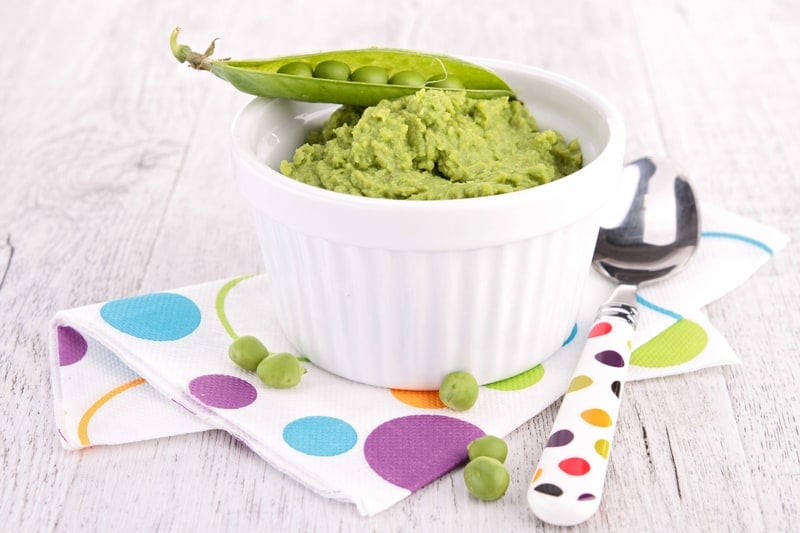
- Vegetables: Broccoli, carrots, sweet potatoes, peas, edamame, leafy greens
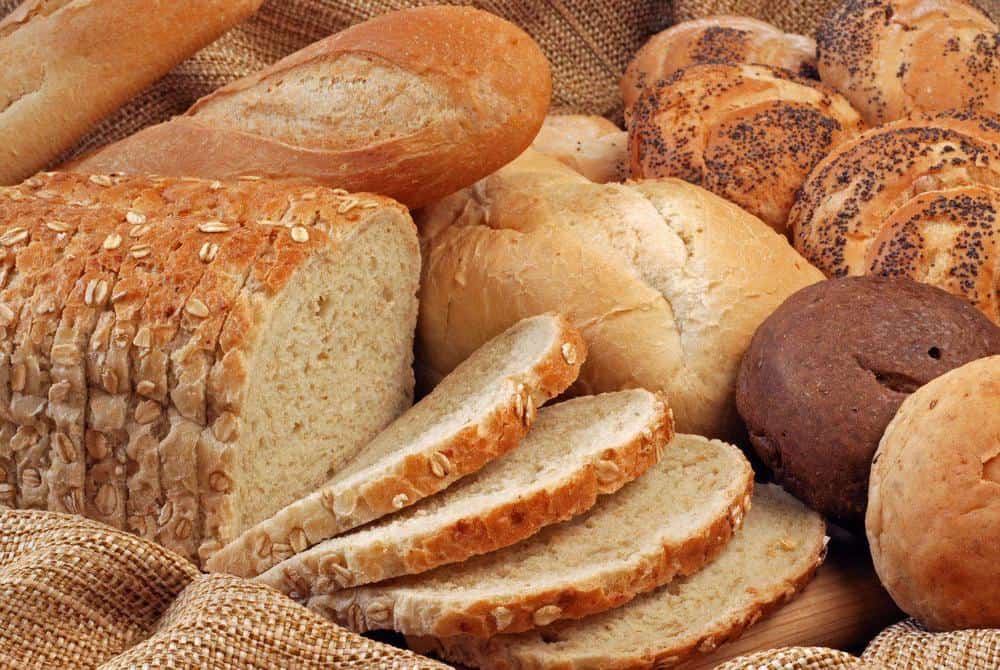
- Grains: Oatmeal, whole wheat bread, whole grain pasta, brown rice, quinoa
- Legumes: Black beans, lentils, chickpeas, split peas (great blended into soups and sauces, where kids never notice them)
- Nuts and seeds: Chia seeds (add to smoothies or overnight oats), flaxseeds (ground), almonds, walnuts
Quick idea: My kids’ favorite fiber-boosting smoothie is frozen banana, frozen mango, spinach, chia seeds, and almond milk. They have no idea there is spinach in it!
A Note On Products I Didn’t Include
There are few products that show up on other “best kids fiber” lists and I wanted to highlight why I didn’t include them here:
Benefiber Chewable Tablets, OLLY Kids Friendly Fiber, and Metamucil Kids Fiber Gummies: I removed these after re-checking their labels against my own standards. Benefiber’s chewable tablets contain artificial sweeteners (sucralose, aspartame, acesulfame potassium) and artificial colors (Red 40, Yellow 6, Blue 1), all of which are on my “avoid” list. OLLY Kids Friendly Fiber contains gelatin (so it is not vegetarian) and added cane sugar. Metamucil Kids Fiber Gummies are actually cleaner than those two (no added sugar, no artificial dyes), but they do not carry third-party certification, and one of my core rules is to favor products with verified independent testing. None of these are “bad,” but they did not meet the bar I hold for products I would put my name behind, so I swapped in cleaner options.
Seed PDS-08 Pediatric Daily Synbiotic: Seed is a high-quality brand I respect, and PDS-08 is impressive, with a generous dose of prebiotic fiber and nine clinically studied probiotic strains for ages 3 to 17. But it is built primarily as a synbiotic (probiotic plus prebiotic) rather than a dedicated fiber supplement, so it did not fit the focus of this particular guide. If you are looking for the best probiotic for kids, it is absolutely worth considering.
SmartyPants Kids Fiber Gummies: SmartyPants makes solid supplements, but their kids’ fiber gummy contains added sugar, which is one of my core “avoid” criteria. With so many kids already getting more added sugar than they should, I didn’t want to recommend a fiber supplement that adds to that load when cleaner options exist.
FAQs
HOW DO I KNOW IF MY CHILD NEEDS A FIBER SUPPLEMENT?
Your child might benefit from a fiber supplement if they struggle with constipation or irregular bowel movements, are picky eaters who avoid fruits, vegetables, and whole grains, have a diet heavy in processed foods with low natural fiber, or have recently taken antibiotics (which can disrupt gut bacteria). Always talk to your pediatrician before starting any supplement.
ARE FIBER SUPPLEMENTS SAFE FOR KIDS?
Yes, fiber supplements are generally safe for children when used as directed. Start with a half dose to let your child’s digestive system adjust, since jumping to a full dose right away can occasionally cause temporary bloating or gas. Make sure your child drinks plenty of water, especially when using psyllium-based products.
IS IT BETTER TO GIVE KIDS FIBER THROUGH FOOD OR SUPPLEMENTS?
Yes! I am for food first, always. Whole foods provide not just fiber but vitamins, minerals, antioxidants, and other compounds that work together in ways a supplement cannot fully replicate. But the reality is that most kids can’t or don’t get enough fiber through food, so I believe supplements are a great safety net when diet falls short.
WHAT’S THE DIFFERENCE BETWEEN PREBIOTICS AND FIBER?
Prebiotics are a type of fiber, specifically a type that feeds the beneficial bacteria (probiotics) in your gut. Not all fiber is prebiotic, but prebiotic fiber is the most beneficial for the gut microbiome. Many of the products on this list (Hiya, bio.me, Begin Health, Culturelle, Zarbee’s, Physician’s Choice) contain specifically prebiotic fiber.
CAN FIBER SUPPLEMENTS HELP WITH CONSTIPATION?
Yes! Both soluble and insoluble fiber can help with constipation. Soluble fiber (like psyllium or PHGG) softens stool by drawing water into the colon. Insoluble fiber adds bulk and helps move things through more quickly. Hiya’s multi-fiber blend addresses both mechanisms, which is part of why I recommend it for kids who struggle with irregularity.
WHAT AGE CAN KIDS START TAKING FIBER SUPPLEMENTS?
This depends on the product. I aimed to include fiber supplements that can be used for kids as young as 1 year old – e.g. bio.me, Begin Health, Culturelle, Physician’s Choice, Zarbee’s, and Hiya and MaryRuth’s start at age 2. Always check the label and consult your pediatrician for children under 2 years old.
CAN MY CHILD TAKE FIBER WITH THEIR MULTIVITAMIN?
Typically yes. Fiber supplements don’t interfere with most vitamins and minerals. However, very high doses of fiber can reduce absorption of certain minerals (like calcium and iron) if taken at the exact same time. To be safe, I typically give my kids their multivitamin and fiber supplement at different times of day.
Final Thoughts
If there’s one takeaway I want you to get from this guide, it’s this: not all fiber supplements for kids are created equal. The supplements on this list represent the best of what’s available, products that use clean ingredients, quality fiber sources, and responsible testing standards.
My #1 recommendation is Hiya Kids Daily Fiber+ for its unmatched combination of a four-source fiber blend, zero added sugar, Clean Label Project certification, and a powder format that is both effective and kid-friendly. For a gentle option that is easy on sensitive tummies, bio.me is excellent. And if your child will only take a gummy, MaryRuth’s is the cleanest one I have found.
Whatever you choose, pair it with a diet rich in whole fruits, vegetables, and grains, and you will be giving your child’s digestive health, and overall wellness, a meaningful boost.
Have a question about a fiber supplement I did not cover, or want to share one that has worked for your family? Leave a comment below. I respond to every single one!
More Healthy Food Guides!
- Best Probiotics for Kids
- Best Multivitamins for Kids
- Best Protein Powders for Kids
- Best Organic Baby Formula
- Healthiest Cereals for Kids
- Best Melatonin-Free Sleep Aids For Kids